A Diamond Exchange cricket ID is a login for a betting exchange positioned toward players moving larger sums. It’s the platform people are pointed to when the sentence “maximum bet” starts appearing at inconvenient moments.
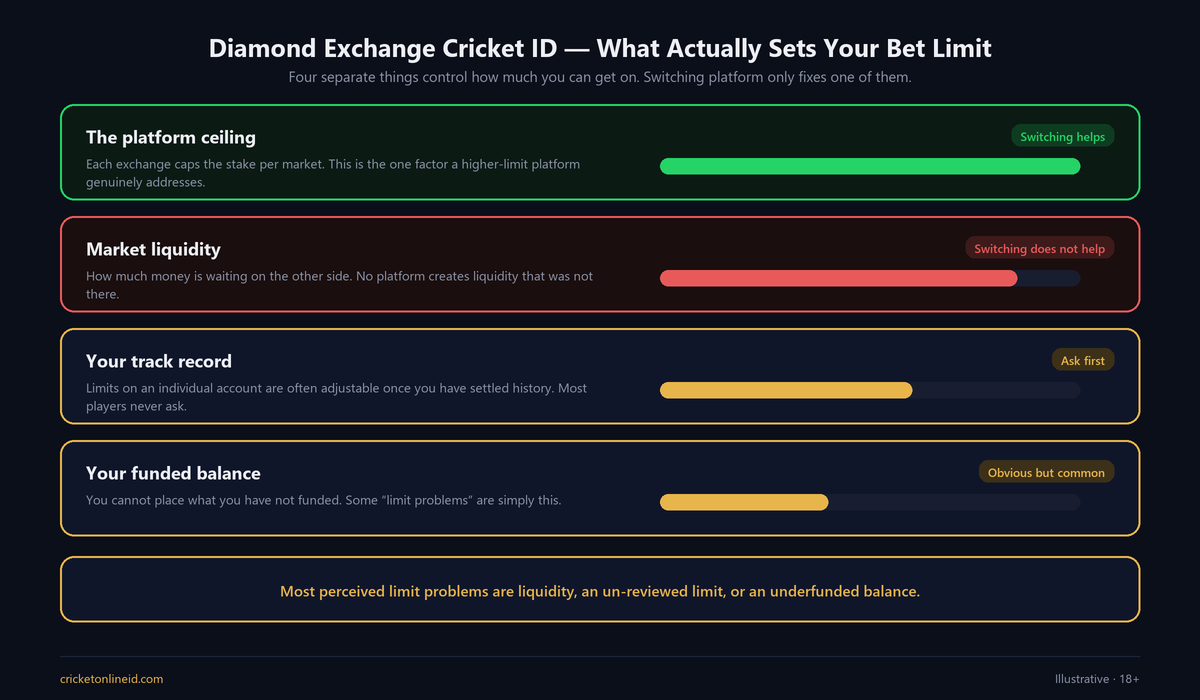
But before you take one, it’s worth knowing something the market rarely tells you: most players who think they have a limit problem don’t. They have a platform problem, a liquidity problem, or a track-record problem — three different things with three different fixes, only one of which is “move to Diamond”.
Access to Diamond runs through an online cricket ID provider rather than a direct sign-up on the platform itself.
And there’s a fourth possibility worth naming plainly, because it’s the one this industry profits from: you may be about to be sold a master ID as the cure for limits, which is almost always the wrong product for an individual player.
This page explains what genuinely determines how much you can put on a market, when Diamond is the right answer, and when it isn’t. If you already know your stakes have outgrown a standard platform, message us and the ID takes about five minutes.
What Is a Diamond Exchange Cricket ID?
A Diamond Exchange cricket ID is a username and password for a betting exchange, where you bet against other players at market-set prices rather than against a house. You can back an outcome (betting it happens) or lay it (betting it doesn’t), and the platform takes a commission on net winnings rather than building a margin into every price.
The exchanges don’t accept direct Indian signups or UPI, so the market runs through providers. We hold the platform relationship, create the account, handle deposits and withdrawals through Indian rails, and send the credentials on WhatsApp. From then on the ID is yours.
A Diamond Exchange ID is also written as diamond exch, or referred to by various numbered forms — the brand appears across many web addresses, as most Indian-facing exchanges do. Two consequences worth flagging immediately: take your working login address from your provider in your existing thread, and be aware there are entirely unrelated businesses in actual diamond trading that share the name. The full verification method is on our Lotus Exchange page.
What Actually Sets Your Bet Limit
This is the section that should exist everywhere and doesn’t. Four separate things determine how much you can get on, and confusing them is what leads people to buy products they don’t need.
1. The platform’s own limits
Every exchange sets a maximum stake per market, and platforms are built for different clienteles. A platform aimed at casual players caps lower than one aimed at serious money. This is the factor Diamond genuinely addresses — its ceilings are higher from the start.
If your stakes are consistently bumping a platform ceiling, this is a real reason to move, and the only one of the four that moving actually solves.
2. Market liquidity — usually the real culprit
Here’s what most players experience as a “limit” but isn’t one.
Liquidity is how much money is waiting on the other side of your bet. It’s not a rule the platform imposes; it’s simply how many people want to take the opposite view at the price you want. On a deep IPL match-odds market there’s enormous depth and you’ll get matched instantly. On a Ranji Trophy session line there may be almost nobody.
When liquidity is thin, three things happen that feel like a limit:
- Partial matching. You ask for a large stake and only part of it fills, because that’s all that was available at your price.
- Price movement against you. Your own bet moves the market. Push size into a thin market and you’re bidding against yourself — the last portion fills at a worse price than the first.
- No exit. You’re in a position and can’t trade out mid-event, because there’s nothing on the other side.
No platform fixes this, including Diamond. Moving to a higher-limit exchange doesn’t create liquidity that didn’t exist in a domestic-cricket market. The fix is to match your stake to the market: size up on deep markets, size down on thin ones. Our online betting ID guide breaks down which sports and tournaments sit in which liquidity tier.
The practical rule, and it’s worth more than most betting advice you’ll read: match your stake to the liquidity, not to your confidence. A brilliant read on a market you can’t exit is worth less than an ordinary read on one you can.
3. Your track record with the provider
Limits on an individual account are frequently adjustable. A settled history of clean deposits and withdrawals is exactly what justifies raising them.
Most players never ask. Ask. It’s a normal request, not a favour, and with us it’s a conversation rather than a purchase. If a provider’s only answer to “can you raise my limit” is “buy a different account type,” you’ve learned something useful about that provider.
4. Your funded balance
Obvious but worth stating: you can’t place what you haven’t funded. Some players diagnose a limit problem when they simply haven’t deposited enough for the position they’re imagining.
Why a Master ID Is Usually the Wrong Fix
This is the most expensive misunderstanding in the Indian cricket ID market, and it gets sold hardest to exactly the players reading a page like this one.
A master ID is an agent-level account. It can create and manage other accounts, allocate points down a tree, set limits for people beneath it and see the whole downline in one dashboard. It is a management console — software for running a network of players.
It gets marketed to individual players as “higher limits, direct exchange access, no agent interference, professional panel”. Read that list again: it is management software being sold to someone who has nobody to manage.
The kernel of truth is that higher tiers often do carry higher limits. But that’s a setting, and on a well-run panel your provider can raise a limit on your ordinary user ID once you have a track record. What a master ID adds beyond that is responsibility for other people’s money — settlement obligations, downline balances, and a set of duties that have nothing to do with your own betting.
When a master ID is genuinely right: you actually have players under you and you’re settling with them. That’s it. If you’re an individual player wanting a bigger stake on a market, it is the wrong product, and any provider whose first answer to a limit question is “take a master panel” is solving their margin rather than your problem.
Our full breakdown of every account type — user, agent, master, super master, plus the credit-versus-deposit distinction that matters far more than any of them — is on the cricket ID types guide.
When Diamond Is Genuinely the Right Move
Having talked you out of three false diagnoses, here’s the real one.
Diamond earns its place when the platform ceiling is the binding constraint — you’re betting deep, liquid markets (IPL match odds, India internationals, major ICC events), you’ve already had your limit reviewed on your current account, and you’re still hitting a maximum you’d like to exceed.
Signs you’re actually there:
- You regularly max out on markets with obvious depth, not obscure ones
- You’ve asked about a limit increase and been told you’re at the platform’s ceiling
- Your typical stake is large enough that partial fills on deep markets are a routine annoyance
- You’re comfortable with the bankroll implications of the stakes you’re describing
Signs you’re not there yet:
- The “limits” you’re hitting are on thin markets — that’s liquidity, and Diamond won’t help
- You haven’t asked your provider for a review
- You’re reasoning from a bad session rather than a sustained pattern
- The stake you want is large relative to money you can comfortably lose
That last point isn’t a sales qualification, it’s the important one. A higher ceiling is not an instruction to use it.
Which Cricket Markets Actually Support Size
If you hold a Diamond Exchange ID for the limits, it helps to know where those limits are usable — because market depth varies enormously and no platform ceiling matters in a market with nobody on the other side.
Match odds on major fixtures — deepest by a distance. IPL matches, India internationals, ICC knockouts. This is where a Diamond Exchange ID earns its keep: the depth genuinely exists, large stakes fill at the displayed price, and you can trade out mid-match without moving the market against yourself.
Match odds on secondary leagues — workable, with care. BBL, CPL, PSL, SA20. Real money goes on, but a large position may fill in parts, and exiting mid-event is less certain. Size somewhat below what you would on an IPL market.
Session and fancy markets — thinner than people expect. These are where experienced Indian players do their best work, and they are also where size runs into trouble fastest. A session line carries far less depth than the match-odds market on the same fixture. A stake that fills instantly on match odds can sit half-matched on a session, and pushing the rest moves the price against you.
Player props and niche markets — small only. Top batter, method of dismissal, next-over specials. Interesting, quick, and not built for volume.
Domestic cricket — knowledge markets, not size markets. Ranji Trophy and similar reward the rare player who actually follows domestic cricket, precisely because few people are watching. That same thinness means they cannot absorb large stakes, and a position you cannot exit is a position you should not have taken at size.
The practical consequence: a Diamond Exchange ID does not turn a thin market into a deep one. It removes the platform ceiling on markets that were already deep. Knowing which is which is the difference between using the higher limits well and discovering their limits expensively.
Bankroll at Higher Stakes
If Diamond is the right move for you, the arithmetic changes in ways worth thinking through before rather than after.
Variance scales with stake size, and it doesn’t care about your reasoning. A run of losing sessions that was uncomfortable at small stakes is materially serious at large ones. The same strategy, the same edge, the same reads — just bigger numbers on both sides. Players who move up and keep their old habits are usually surprised by the size of the swings, and surprise is an expensive emotion in this game.
Fixed fractions beat fixed amounts. Staking a consistent percentage of your bankroll rather than a fixed rupee figure means your stakes shrink automatically during a bad run and grow during a good one. It’s unglamorous and it’s what keeps people in the game.
Withdraw on a schedule, not on a feeling. At higher stakes the case for taking money off the platform regularly gets stronger, not weaker. A balance you don’t intend to bet this week belongs in your bank account — safer there than in any betting wallet, ours and Diamond’s included.
Commission compounds at size. An exchange takes a percentage of net winnings. At small stakes that’s a rounding error; at large ones it’s a real line item worth understanding before you start.
Tax is not optional and gets harder to ignore as stakes rise. Betting winnings in India are taxable at a flat 30% plus cess, with no deductions and — importantly — no offsetting of losses against winnings. A year in which you won ₹8 lakh and lost ₹7 lakh is not a ₹1 lakh profit in tax terms — see the tax guide for worked scenarios. Offshore platforms generally don’t deduct at source, which means declaring is your responsibility. If you’re playing at the level this page describes, talk to a tax professional; any provider implying winnings are untraceable is not someone to take financial advice from.
Withdrawals at Size
Worth setting expectations honestly, because this is where larger players run into friction.
Withdrawals are paid back to the same UPI account you deposited from — traceable in both directions, and the rule that blocks the most common account-takeover attack. Most are processed same-day.
Larger withdrawals can take longer, and on a busy tournament night longer still. That’s normal. What matters is that you get a specific timeline, not silence. The single most reliable warning sign in this market isn’t delay — it’s a provider who goes quiet when a withdrawal is raised.
Two habits worth adopting if you’re moving real money:
Test the pipeline before you need it. Take a small withdrawal early, before you have a large balance riding on the answer. Learning your provider handles it well is worth far more when it’s cheap information.
Don’t let a balance accumulate because it’s convenient. The convenience is real; so is the concentration of risk.
Diamond vs Lotus vs Sky
We issue IDs on all three, so there’s no reason to steer you.
| Diamond | Sky | Lotus | |
|---|---|---|---|
| Strongest at | Higher limits, larger stakes | In-play speed, odds refresh | Breadth — cricket plus deep casino |
| Best for | Players whose stakes hit ceilings | Live in-match traders | Sport plus card games, one wallet |
| Weaker on | Overkill at casual stakes | Casino depth | In-play responsiveness |
| Skip it if | You bet small — you’re paying for headroom you won’t use | You never bet during matches | Casino access is a weakness for you |
Straight guidance:
- Genuinely hitting platform ceilings on liquid markets? Diamond.
- Bet live during matches? Sky Exchange — refresh speed is the whole game there.
- Want breadth and casino under one login? Lotus Exchange, with a rule set in advance for the shared wallet.
- New to exchanges? Cricbet99 ID, and don’t let anyone sell you a high-limit account in month one.
Many regular players hold two IDs and compare prices before big matches. Your KYC carries over with us, so a second takes minutes. Full comparison: best cricket exchange.
How to Get a Diamond Exchange Cricket ID
1. Message us and describe how you actually bet. Stake sizes, markets, whether you’ve hit ceilings. If your issue is liquidity or an un-reviewed limit rather than a platform ceiling, we’ll say so — that’s a cheaper fix than switching platforms and we’d rather you had it.
2. Verify, then deposit. One-time KYC, then UPI, PhonePe or Google Pay. Platform, amount, any bonus and its wagering conditions, and withdrawal terms all confirmed in writing before you pay.
3. Get your credentials and the verified login address. ID and password arrive in the same thread, usually within five minutes. Change the password on first login, and take any future address change only from that thread.
Then test a small withdrawal early — especially at these stakes, where knowing beats trusting.
Common Diamond Exchange Problems
“The site won’t load.” Usually a domain change rather than an outage. Don’t search for a replacement address — ask in your provider thread. Searching is the single most exploited moment in this market.
“My bet only partially matched.” That’s liquidity, not a limit. There wasn’t enough on the other side at your price. Size to the market, or accept a worse price for the remainder.
“My limit hasn’t increased.” Ask for a review with your track record. If you’re genuinely at the platform ceiling, that’s when moving makes sense.
“I forgot my password.” Message your provider from your registered number for a KYC-verified reset, usually within minutes.
“Is there a Diamond Exchange app or APK?” You don’t need one — the browser does everything. Third-party APK portals are a real risk, because an installed Android app can request access to your SMS and OTPs in a way a browser tab cannot.
“A market settled wrong.” Screenshot the market and your bet slip, then raise it. Settlement can be corrected; memory can’t.
“My withdrawal is slow.” Ask for a timeline. Larger amounts and busy nights genuinely take longer. Silence is the warning sign, not delay.
Higher limits are not the only reason people move platform: a Laser247 cricket ID gets picked for faster settlement, and an 11xplay ID for casino and card games sharing one wallet.
Frequently Asked Questions
What is a Diamond Exchange cricket ID?
A login — username and password — for the Diamond betting exchange, giving you back-and-lay access to cricket markets. It’s positioned toward players moving larger sums, with higher platform limits than most Indian-facing exchanges.
How do I get a Diamond Exchange ID?
Message us on WhatsApp and ask for a Diamond Exchange ID., complete a one-time KYC check, deposit by UPI once terms are confirmed in writing, and your login arrives in the same chat — usually within five minutes.
Does Diamond Exchange really have higher limits?
Its platform ceilings are higher, yes. But platform ceilings are only one of four things that determine how much you can get on — market liquidity, your track record and your funded balance matter too, and moving platforms only fixes the first.
Why did my large bet only partially match?
Liquidity, not a limit. Only part of your stake found someone on the other side at your price. Deep markets like IPL match odds fill instantly; thin markets like domestic cricket may not fill at all.
Do I need a master ID to get higher limits?
Almost certainly not. A master ID is a management account for people running a network of players. Limits on an ordinary user ID can usually be raised by your provider once you have a track record — ask before buying a different account type.
Is Diamond Exchange right for a beginner?
No. Start on something simpler like Cricbet99. A higher ceiling is not useful to someone still learning which markets to bet, and it removes a guardrail you’d benefit from.
What is a Diamond Exchange panel?
“Panel” generally refers to the agent-side dashboard used to manage accounts beneath a master or super master. It’s a tool for network operators, not an upgraded betting account for individual players.
How fast are withdrawals at higher stakes?
Most are same-day, always back to the same UPI account you deposited from. Larger amounts and busy tournament nights take longer — you should get a specific timeline rather than silence.
Do I pay tax on large betting winnings in India?
Yes — a flat 30% plus cess, with no deductions and no set-off of losses against winnings. Offshore platforms typically don’t deduct at source, so declaring is your responsibility. At significant stakes, speak to a tax professional.
Should I move to Diamond just because I can afford bigger bets?
No. A higher ceiling is an option, not an instruction. Move when the platform limit is genuinely the binding constraint on liquid markets — not because a bigger number is available.
Get your Diamond Exchange cricket ID on WhatsApp — and if a limit review on your existing ID is the better answer, we’ll tell you that instead. 18+ only. Bet responsibly, and only what you can afford to lose.