A bonus is not free money and it is not a scam. It is a conditional credit, and the conditions are the entire story.
Most disputes about bonuses in this market aren’t really about the bonus. They’re about someone discovering a condition at withdrawal time that they were never shown at deposit time. The condition was usually standard. The problem was that nobody explained it.
Bonus terms are written by the platform, not by the online cricket ID service that issued your login.
This page explains the arithmetic — how wagering requirements work, what the numbers mean in practice, and which terms are worth asking about before you deposit rather than after.
No recommendations here about whether to take a bonus. That depends entirely on how much you were going to play anyway, and only you know that.
The Core Concept: Wagering Requirement
Almost every bonus carries a wagering requirement — sometimes called rollover or playthrough. It is the amount of turnover you must generate before the bonus credit, or winnings derived from it, become withdrawable.
It is usually expressed as a multiple: 5x, 10x, 20x.
Worked example. You deposit ₹5,000 and receive a 100% bonus — another ₹5,000 in credit. The wagering requirement is 10x on the bonus.
| Amount | |
|---|---|
| Your deposit | ₹5,000 |
| Bonus credit | ₹5,000 |
| Wagering requirement (10× bonus) | ₹50,000 of turnover |
That ₹50,000 is turnover, not losses. You are not required to lose ₹50,000 — you’re required to place ₹50,000 worth of bets. The same money can be staked, settled and staked again many times over. If you typically stake ₹1,000 a bet, that’s 50 bets.
This distinction matters enormously and is the single most misunderstood part of the subject.
The Four Questions That Determine Everything
Two bonuses advertised as “100% up to ₹10,000” can be completely different products. These are what separate them.
1. What is the multiple applied to?
Bonus only (10 × ₹5,000 = ₹50,000) or deposit plus bonus (10 × ₹10,000 = ₹100,000)?
Same headline, double the requirement. Always worth asking which.
2. What counts toward the requirement?
Some terms count all bets. Others exclude certain markets, or count them at a reduced rate. Common patterns include excluding very low-odds bets, or counting some market types at a fraction of their value.
On a platform carrying both sport and casino, sports and casino turnover may count differently. That’s worth knowing before you plan around it.
3. What are the minimum odds?
Many bonuses only count bets above a minimum price. If bets below, say, 1.50 don’t count, then a strategy of repeatedly backing heavy favourites won’t progress your requirement at all — even though it looks like the safest way to generate turnover.
4. Is there a time limit?
Requirements often expire — 7 days, 30 days. An achievable rollover on an unlimited timescale can be unachievable in a week if you don’t play that often.
Doing the Arithmetic Honestly
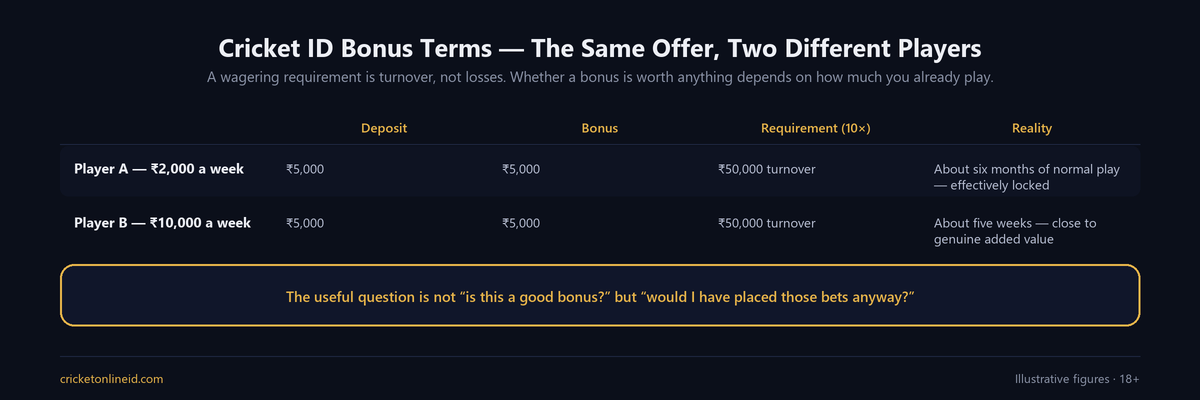
The useful question isn’t “is this bonus good?” It’s “would I have generated this turnover anyway?”
Two people, identical offer, opposite answers:
Player A bets roughly ₹2,000 a week. A ₹50,000 requirement is around six months of their normal activity. For them the bonus is effectively locked — and if it carries a 30-day limit, it’s unreachable without changing how they play.
Player B bets ₹10,000 a week across several matches. The same requirement is five weeks of normal activity. They’d have placed those bets regardless, so the bonus is close to genuine additional value.
Same bonus. Completely different thing.
The trap is Player A deciding to bet like Player B in order to “unlock” the bonus. At that point the bonus has changed their behaviour, which is what a wagering requirement is designed to do. Turnover generated to chase a bonus is turnover you’d otherwise not have risked.
That’s not an argument against bonuses. It’s an argument for doing the multiplication before you deposit rather than after.
Terms Worth Confirming in Writing
Before depositing, these are reasonable to ask for — and a straightforward provider will give them without friction:
- The bonus amount and what triggers it
- The wagering multiple, and whether it applies to bonus or deposit-plus-bonus
- Which markets count, and at what rate
- Minimum odds for a bet to count
- Any time limit
- Maximum withdrawal from bonus winnings, if capped
- What happens if you withdraw before completing the requirement — typically the bonus and its winnings are forfeited
- Whether the bonus locks your deposit too, or only itself
That last one is the most important and the least asked. On some structures, taking a bonus restricts withdrawal of your own deposited money until the requirement is met. That converts a bonus from “extra credit” into “a lock on funds you already had” — a completely different proposition.
Get it in writing before you pay. A screenshot of the terms in your chat, timestamped, is what resolves a dispute later. This is the same principle as everything else in the deposit guide.
Where This Becomes Fraud
Standard bonus terms are not fraud, even when the requirement is high. Fraud is a different thing and it looks like this:
Terms that appear only at withdrawal. If a condition is produced for the first time when you try to take money out, and was never stated at deposit, that isn’t a bonus condition — that’s a story invented to keep your money.
Escalating bonuses used as pressure. An offer that climbs each time you hesitate — 100%, then 200%, then “today only” — isn’t a commercial offer. Urgency exists to stop you checking.
A “fee” to release bonus winnings. No legitimate structure requires an additional payment to unlock funds. This is the recognised final step of a fraud, covered in the scam guide.
Requirements that change after the fact. Terms fixed in writing before deposit cannot be revised afterwards. This is precisely why the written record matters.
The distinction is simple: a real condition is disclosed before your money moves. An invented one appears after.
A Reasonable Way to Think About It
Neutral, no recommendation either way:
- A bonus is worth roughly what it’s worth after you account for the requirement, the eligible markets, and the time limit.
- If you would have generated the turnover anyway, it’s close to real value.
- If unlocking it requires playing more than you planned, the bonus is setting your stakes rather than you.
- A smaller bonus you fully understand is more useful than a larger one you don’t.
- If the terms can’t be produced in writing before you deposit, the size of the bonus is irrelevant.
And the simplest test, which needs no arithmetic at all: can you explain the bonus to a friend in one sentence? If not, you don’t yet know what you’re accepting.
Wagering maths is easier to judge once you know what a cricket betting ID actually costs to run, and how the platforms differ in our cricket exchange comparison.
Frequently Asked Questions
What is a wagering requirement on a cricket ID bonus?
The amount of turnover you must generate before the bonus credit, or winnings from it, can be withdrawn. It’s usually a multiple — for example 10× a ₹5,000 bonus means ₹50,000 of bets placed.
Does a 10x wagering requirement mean I have to lose that money?
No. It’s turnover, not losses. The same funds can be staked, settled and staked again repeatedly. A ₹50,000 requirement at ₹1,000 a bet is 50 bets, not ₹50,000 of losses.
Is the multiple applied to the bonus or the deposit?
It varies by offer, and it doubles the requirement if it applies to both. Always confirm which before depositing.
Do all bets count toward the requirement?
Not always. Some terms exclude certain markets, count them at a reduced rate, or require a minimum price. On mixed platforms, sports and casino turnover may count differently.
Can I withdraw before completing the wagering requirement?
Usually you can withdraw your own funds, but the bonus and any winnings from it are typically forfeited. Some structures also restrict your deposit until the requirement is met — worth confirming specifically.
Are high wagering requirements a scam?
No. A disclosed condition is a condition, however demanding. Fraud is when terms appear for the first time at withdrawal, or when an extra payment is demanded to release funds.
What should I confirm before accepting a bonus?
The multiple and what it applies to, which markets count and at what rate, minimum odds, any time limit, any withdrawal cap, and whether your own deposit is locked too. In writing, before paying.
Someone is asking for a fee to release my bonus winnings — is that normal?
No. No legitimate bonus structure requires an additional payment to unlock funds. That request is a recognised fraud pattern.
Is a bigger bonus always better?
Not necessarily. A bonus is worth what remains after the requirement, eligible markets and time limit are accounted for. A smaller offer you understand is more useful than a larger one you don’t.
Ask for bonus terms in writing before you deposit — any straightforward provider will give them. 18+ only.
Ready for your online cricket ID? Verified IDs for every major exchange, delivered on WhatsApp in minutes.
Get ID on WhatsApp