There is no best cricket exchange. There is only the best one for how you bet, and those are genuinely different answers.
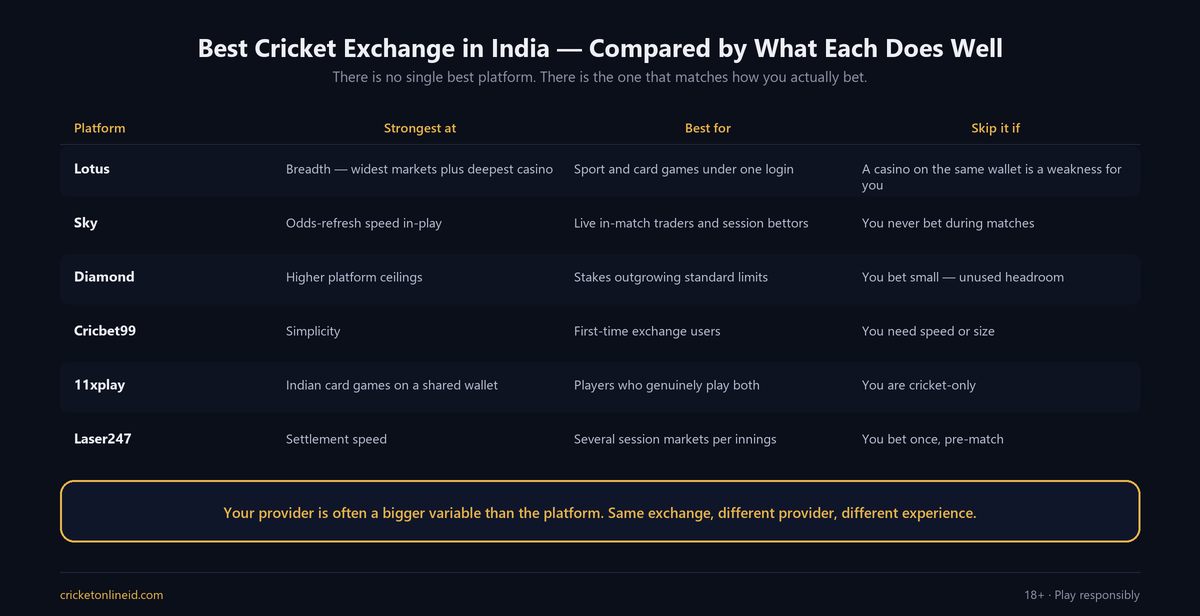
That’s an unsatisfying opening for a page with this title, so let’s be concrete about why it’s true. A player who places one bet before the toss and checks the score at dinner needs nothing that a live in-play trader needs. A player whose stakes are outgrowing standard limits has a problem that no amount of casino depth solves. Someone who has never used an exchange should not be on the platform built for someone moving lakhs.
Comparing platforms only matters once you have picked an online cricket ID provider, because the provider is who actually issues your login.
Every “top 10 exchanges” page you’ll find ranks by who paid for the placement, describes all ten as India’s most trusted, and helps nobody. This page does the opposite: it names what each platform is genuinely good at, what it’s weak at, and — the part that matters most — which questions about your own betting decide the answer.
We issue IDs on all of these, so we have no reason to push you toward one over another. What we do have a reason to do is put you somewhere you’ll still be happy in six months.
Start Here: Four Questions That Decide It
Answer these honestly and the choice mostly makes itself.
1. Do you bet during matches, or before them? If you watch matches with the app open and react to wickets, run rates and collapses, odds-refresh speed is your single most important variable — it decides whether the price you click is the price you get. If you place a bet pre-match and check later, refresh speed is worth nothing to you and you should ignore it entirely.
2. Are you hitting maximum-bet limits? Genuinely hitting them, on liquid markets, repeatedly — not once on an obscure market during a bad session. If yes, platform ceilings matter. If no, ignore limits completely; you’d be paying for headroom you never use.
3. Do you want casino and card games on the same balance? Some players want teen patti and andar bahar behind the same login. Others know that’s a weakness for them and want the opposite. Both are legitimate. Be honest with yourself, because a shared wallet is convenient right up to the moment it isn’t.
4. Have you used a betting exchange before? If not, the answer is simple and it is not the most powerful platform. Start with the simplest interface and the smallest deposit, and move later.
The Comparison Table
| Platform | Best at | Best for | Weaker on | Skip it if |
|---|---|---|---|---|
| Lotus | Breadth — widest markets plus deepest casino | Players who want sport and card games under one login | In-play responsiveness | Casino access is a weakness for you |
| Sky Exchange | Odds-refresh speed in-play | Live in-match traders, session bettors | Casino depth | You never bet during matches |
| Diamond Exchange | Higher platform limits | Stakes outgrowing standard ceilings | Overkill at casual stakes | You bet small |
| Cricbet99 ID | Simplicity | First-time exchange users | Heavy session volume | You need speed or size |
| 11xplay | Indian card games on a shared wallet | Players who genuinely play both sport and cards | Sports depth vs Lotus | You’re cricket-only |
| Laser247 | Settlement speed | Traders running several sessions per innings | Not the broadest platform | You bet once pre-match |
| TigerExch | General-purpose middle ground | — | No standout specialism | You have a specific need above |
How to read this table: the “Best at” column is the only one that should move your decision. Every platform here shows the same matches, offers back and lay, takes UPI through a provider and pays back to the same account. The differences are real but narrow, and they only matter where they intersect with how you actually bet.
The Recommendation, by Player Type
If you’ve never used an exchange
Take a free demo ID first, then Cricbet99.
The demo costs nothing and carries dummy balance on real live markets. Spend one match watching how match odds move on a wicket and how a session line drifts — you’ll learn more in twenty minutes than from any guide.
Then a plain user ID on the simplest platform, funded with the platform minimum. Not a “starting bankroll” — the minimum. Your first month’s money is tuition, and the cheapest tuition is the best kind.
What to ignore in month one: bonuses, limits, in-play, laying, casino, and anyone selling you a master ID. All of it is a solution to a problem you don’t have yet. Our cricket ID types guide explains why the master-ID pitch is aimed squarely at beginners and why it’s almost always wrong for them.
If you bet pre-match and check the result later
Lotus, and don’t overthink it.
Speed advantages are invisible to you. Limits probably aren’t binding. What you get from Lotus is breadth — the widest tournament coverage, football and tennis for the cricket off-season, and the deepest casino if you want it.
That last point comes with the one caveat on this page worth repeating: a shared sports-and-casino wallet is genuinely convenient and genuinely risky, because the tables are one tap from your cricket balance at exactly the moment a losing bet makes you want action. Set a separate casino figure in advance or choose a platform without one.
If you trade live during matches
Sky.
In-play, your edge has a shelf life measured in seconds. A wicket falls, you know the incoming batter is out of form and the required rate has become unrealistic — that read is worth something only if you can act at the price you saw. On a lagging platform you get stale prices, partial fills and messy trade-outs, and none of that shows up in a feature list. It shows up in your balance over a season.
Speed doesn’t create an edge. It stops a real one leaking away.
If you run several session markets per innings
This is the most under-appreciated distinction in the market. Settlement speed is not withdrawal speed. Settlement is how quickly a resolved market credits your platform balance; withdrawal is how quickly that balance reaches your bank. They’re different steps with different timescales.
If you’re trading four or five session windows in an innings, slow settlement locks your own money in already-decided positions — so you either sit out the next window or fund it with fresh money you hadn’t planned to commit. Fast settlement lets one bankroll work several times in a match. Nothing about your edge changes; the mechanics do.
If your stakes are hitting ceilings
Diamond — but diagnose first, because most people are wrong about this.
Four separate things control how much you can get on, and only one of them is fixed by switching platform:
- The platform ceiling — the real reason to move to Diamond
- Market liquidity — how much money is waiting on the other side. No platform fixes a thin market
- Your track record — limits are often adjustable; most players never ask
- Your funded balance — you can’t place what you haven’t deposited
If your “limit problem” is really liquidity, moving platform changes nothing. Ask your provider for a limit review before you switch — it’s a normal request, and it’s free.
If you want cricket and card games together
11xplay for Indian card games specifically, Lotus Exchange for maximum breadth.
Both put sport and casino on one wallet. 11xplay leans toward teen patti and andar bahar; Lotus is wider across everything. The shared-wallet caution applies identically to both — it’s a property of the architecture, not the brand.
If you’re leaving your current platform
Read the switching guide before you move anything.
The key question is whether your problem is the platform or the provider. Slow withdrawals, vague answers, terms revealed late and silence when it matters are provider problems — and changing exchange fixes precisely none of them. Withdraw everything before you announce you’re leaving, let open positions settle, and screenshot your history first.
What Actually Differentiates Exchanges (And What Doesn’t)
Matters, in this order:
- Whether it does the one thing you need. Not “is it good” — is it good at your thing.
- Liquidity in the markets you personally bet. A platform with deep IPL match-odds liquidity can be thin on the session lines where you do your real work. This is invisible on every comparison table including this one, and obvious after one match on a demo ID.
- Whether your provider services it well. Two people on the same exchange with different providers get materially different withdrawal speeds, support and honesty. The provider is often a bigger variable than the platform — and no comparison article accounts for it.
- Limits, honestly assessed — per the diagnosis above.
Doesn’t matter nearly as much as the marketing suggests: bonus size, number of games advertised, interface polish, app availability, and any “India’s #1” claim (all of which are self-awarded).
The test that beats this entire page: take a free demo ID, use it on a real match, and take a small real withdrawal in your first week. Two hours of that tells you more than every comparison page in this market.
What’s Identical Across All of Them
Worth stating plainly, because it narrows the decision usefully.
Back and lay. Every platform here is an exchange, so you can bet for and against outcomes and trade a position mid-match. That mechanic — with worked numbers — is on our cricket betting ID guide.
The market types. Match odds, session and fancy markets, player props, full in-play. What varies is depth and speed, not existence.
The money process. UPI, PhonePe or Google Pay in; withdrawals back to the same account you deposited from, on every platform, with no exception. That rule is what makes the money traceable both ways.
Commission. Every exchange takes a percentage of net winnings, charged only where you finish ahead. It’s the genuine cost of exchange betting and the reason exchange prices beat bookmaker prices.
Tax. Betting winnings in India are taxable at a flat 30% plus cess, with no deductions and no offsetting of losses against winnings. Offshore platforms generally don’t deduct at source, so declaring is your responsibility. Speak to a professional if you play at any scale.
The ID is free. On all of them. Anyone charging a “creation fee” or “activation charge” is running a scam — that one is binary, with no legitimate exception anywhere in this market.
Can You Use More Than One?
Yes, and a lot of regular players should.
Price comparison. Two exchanges rarely show identical prices on the same market. Checking both before a big fixture takes a minute and occasionally finds meaningfully better value.
Playing to each platform’s strength. A fast one for live trading, a broad one for everything else. You stop compromising on either.
Redundancy. Platforms have outages and domain changes, invariably at inconvenient moments. A second working ID means a technical problem doesn’t cost you a match.
Your KYC carries over with us, so a second ID takes minutes rather than a fresh signup. The only real cost is keeping track of two balances — a discipline worth having anyway.
Choosing a Provider Matters More Than Choosing a Platform
This is the part comparison pages never say, and it’s the most important thing here.
The exchanges are broadly reliable. Where money actually goes missing in this market is the provider relationship — the person who issues your ID, takes your deposit and processes your withdrawal.
Four tests. Apply them to us as readily as to anyone else:
They verify you before taking money. KYC first is the entire accountability mechanism. It feels like friction; it’s the only structural protection either side has. A provider who doesn’t want to know who you are has built themselves an exit.
They put terms in writing before payment. Platform, deposit, bonus and its wagering requirement, withdrawal method and timeline — in the chat, before you pay. If it exists only in a voice note, it doesn’t exist.
They’re relaxed about a small test withdrawal. Ask to take a small amount out in your first week. A real provider is untroubled by this. Reluctance here is the most reliable warning sign in this market.
They tell you when you don’t need what you’re asking for. A provider whose answer to every question is the more expensive product is optimising for their margin, not your outcome.
The full method — including how to verify a WhatsApp number is genuine and the behavioural tells that separate real from fake — is on our cricket ID WhatsApp guide.
How to Get Started
1. Message us and describe how you bet. Not what you want — how you actually play. When you bet, what markets, roughly what stakes, whether you watch live. We’ll name a platform and tell you why.
2. Take the demo first if you’re new. Free, dummy balance, real markets. There is no downside and we’d rather you started there.
3. Verify, then deposit. One-time KYC, then UPI once terms are confirmed in writing.
4. Test a withdrawal early. Small amount, first week, on any provider including us. Knowing beats trusting.
Frequently Asked Questions
Which is the best cricket exchange in India?
There isn’t one — it depends on how you bet. Sky for live in-play trading, Lotus for breadth and casino, Diamond for higher limits, Cricbet99 for beginners, Laser247 for fast session settlement, 11xplay for Indian card games. The four questions at the top of this page decide which applies to you.
What is the best cricket exchange for beginners?
Cricbet99, after a free demo ID. The simplest interface, small stakes are normal there, and there’s less on screen to click by accident while you’re still learning.
Which cricket exchange is fastest for in-play betting?
Sky Exchange has the strongest reputation for odds-refresh speed, which is what decides whether the price you click is the price you get. If you don’t bet during matches, this advantage is worth nothing to you.
Which exchange has the highest betting limits?
Diamond Exchange has higher platform ceilings. But most perceived “limit problems” are actually market liquidity, an un-reviewed account limit, or an underfunded balance — and switching platform only fixes the first.
Is one exchange safer than another?
The bigger safety variable is your provider, not the platform. Whoever issues your ID handles your deposits and withdrawals, so their verification process, written terms and withdrawal reliability matter more than which exchange sits behind the login.
Can I have IDs on more than one cricket exchange?
Yes, and many regular players do — for price comparison, to play to each platform’s strengths, and for redundancy during outages. Your KYC carries over, so the second takes minutes.
Do the odds differ between cricket exchanges?
Yes, though usually not dramatically. Because exchange prices are set by the players on them, liquidity differences produce genuinely different prices — which is exactly why holding two IDs and comparing before a big match is worth the minute it takes.
Which cricket exchange has the best bonus?
The wrong question. Every welcome bonus carries a wagering requirement — the turnover you must generate before it becomes withdrawable. A bonus you haven’t read the conditions on is a restriction on your own money, not free value — the bonus terms guide shows why the same offer means different things to different players. Provider reliability is worth far more over a season.
How much does it cost to get an ID on any of these?
Nothing. The ID is free on every platform here; you fund your own balance and the exchange takes a commission on net winnings. Anyone charging a creation or activation fee is a scammer.
What if I choose wrong?
You switch, and it costs very little. Your KYC carries over, your cricket knowledge is fully portable, and the main real cost is rebuilding any raised limits on the new account. Read the switching guide before moving money.
Tell us how you actually bet and we’ll recommend a platform straight — including “take the free demo first” when that’s the honest answer. 18+ only. Bet responsibly, and only what you can afford to lose.