Ask three cricket ID providers what “master ID” means and you’ll get three answers, two of which are trying to sell you something. The vocabulary in this market is genuinely confusing, partly because it evolved on WhatsApp rather than in documentation, and partly because confusion is profitable — a player who doesn’t understand the hierarchy is easier to upsell into an account he doesn’t need.
So here is the honest version. There are two completely different ways cricket ID types get categorised, and mixing them up is the source of most of the confusion. We’ll cover both, and then tell you plainly which one you need. Spoiler for most readers: it’s the cheapest one.
Whichever type you end up with, the starting point is the same online cricket ID, issued by a provider who holds the platform relationship for you.
The Two Ways Cricket IDs Are Categorised
By position in the account hierarchy — user, agent, master, super master, admin. This describes authority: what your account can do to other accounts. This is the real technical structure of every betting exchange panel.
By use case — IPL ID, live betting ID, WhatsApp ID, sports ID, demo ID. This describes how you use it. These aren’t different account types at all; they’re marketing labels for the same user account pointed at different situations.
Most articles on cricket ID types quietly blend the two, which is how a reader ends up believing an “IPL betting ID” is a distinct product with distinct pricing. It isn’t. Let’s take the hierarchy first, because that’s the part with real consequences.
The Cricket ID Hierarchy — How Exchange Panels Are Actually Built
Every betting exchange runs on a tree. Points flow down it, settlement flows back up it. From the bottom:
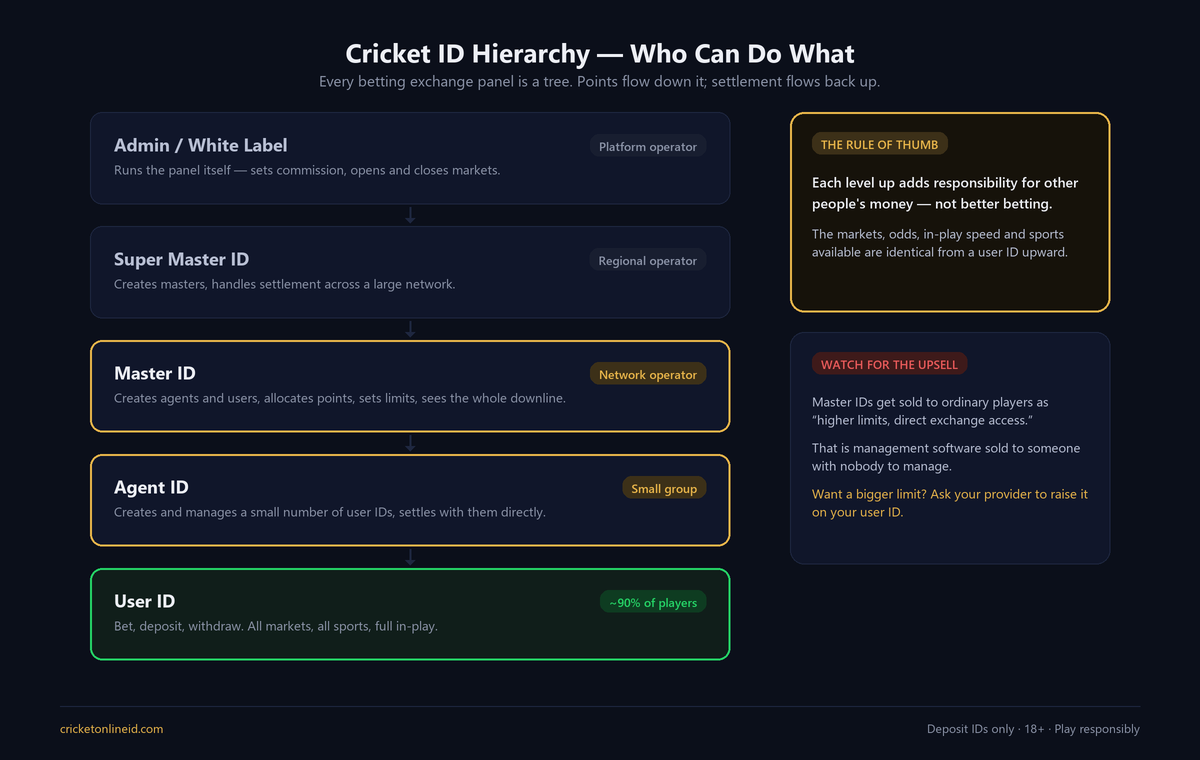
1. User ID (also: client ID, player ID)
The standard cricket ID. You log in, you see markets, you bet, you deposit, you withdraw. You cannot create other accounts and you cannot see anyone else’s activity.
Who needs it: you, almost certainly. Around nine in ten players never need anything else, and every feature people imagine they’re missing — bigger markets, in-play, sessions, casino, football — is already available on a plain user ID. What varies is your limit, and limits are raised on a user ID by track record and balance, not by buying a different account type.
2. Agent ID
A step up: an agent account can create and manage a small number of user IDs beneath it and sees their balances and P&L. Agents typically settle with their players directly, in cash or by UPI, and earn from the difference between what the exchange gives them and what they pass on.
Who needs it: someone who genuinely brings other players — a group of friends who bet together and want one person handling money, or a small local network.
3. Master ID
Same idea, more authority. A master ID sits above agents, can create both agents and users, allocates points down the tree, sets limits per account, and sees the whole downline in one dashboard. It’s a management console, not a better betting account.
Who needs it: people running a network with agents under them. That’s it.
The upsell to watch for: master IDs get marketed to ordinary players as “higher limits, no agent interference, direct exchange access, professional dashboard.” Read that carefully — it’s selling management features to someone who has nobody to manage. If your goal is a bigger bet limit on your own account, ask your provider to raise your limit. If they can only solve that by selling you a master panel, they’re solving their problem, not yours.
There is a legitimate version of this: a genuinely high-stakes player sometimes takes a master account for the transparency of seeing settlement in real time. Fine. But that’s a small group, and if you’re reading a page called “all cricket ID types” to find out what you need, you’re statistically not in it.
4. Super Master ID
Above master: creates masters, manages the layer beneath them, handles settlement across a large tree. This is regional-operator territory — running a business, not playing cricket.
5. Admin / White Label
Top of the tree. Whoever runs the panel itself: sets commission structures, opens and closes markets, controls the whole platform. You will not be offered one of these by a WhatsApp provider, and if you are, ask yourself why.
The rule of thumb: each level up the hierarchy adds responsibility for other people’s money, not better betting. If you’re not managing other people’s money, going up the tree buys you nothing and adds obligations you don’t want.
Demo Cricket ID
A practice account funded with dummy balance. Real interface, real live markets, fake money.
A demo cricket ID is the most underrated thing in this market and it costs nothing. Twenty minutes watching real odds move on a live match teaches you more than any guide — including this one. You see how match odds swing on a wicket, how a session line drifts as the run rate climbs, how quickly in-play prices move when a chase tightens.
Who needs it: everyone, before their first real bet. Ask us and we’ll set one up. We give them away freely for an unromantic reason: players who understand the markets stay in the game longer, and players who don’t tend to lose their first deposit in a week and leave. The incentives happen to align.
One warning: demo balances make people brave in a way real money never does. Don’t read a good demo week as evidence of skill. It’s evidence you’ve learned the interface, which is all it’s meant to prove.
How to use a demo cricket ID properly: open it during an actual live match rather than poking at it on a quiet afternoon. Watch a single market — match odds is fine — through a full innings and notice what moves it. Then watch a session line for six overs. Then, only then, place some pretend bets and see whether your instinct about the game translates into the numbers. Two matches of that is worth more than a month of reading, this page included.
VIP Cricket ID
Not a separate account type — a user ID with better terms. Typically higher limits, priority withdrawals, and a named support contact who knows your history instead of whoever answers the chat.
Who needs it: established players, or players opening with a substantial bankroll. It isn’t something to buy on day one, and any provider selling “VIP status” as a package to a brand-new customer is selling a badge. With us it’s earned by track record or justified by deposit size, and we’ll tell you plainly which side of that line you’re on rather than taking the money.
Credit ID vs Deposit ID — The Distinction Nobody Explains
This one matters more than the whole master ID conversation, and almost nobody writes about it.
A deposit ID works how you’d expect: you put money in, your balance goes up, you bet from your own funds, you withdraw what’s left. Your maximum loss is what you deposited. This is what we issue.
A credit ID is issued with a points balance you haven’t paid for. You bet on credit and settle up with your agent afterwards — weekly, usually — paying if you’re down, collecting if you’re up. It’s common in the traditional Indian agent networks and it’s how a lot of people first encounter betting exchanges.
The appeal is obvious: no money upfront. The problem is equally obvious once stated: you can lose more than you have. A deposit ID’s worst case is a zero balance. A credit ID’s worst case is a debt to someone whose collection process isn’t a customer service department. Every genuinely bad story in this market — the ones that stop being about money and start being about pressure — involves credit, not deposits.
If someone offers you a cricket ID with a free starting balance and no deposit, understand clearly what you’re being offered before you accept. We don’t issue credit IDs, and that isn’t a marketing position. Why that distinction matters for risk is covered in our guide to betting limits that actually hold.
The Use-Case Labels (And Why They Aren’t Really Types)
You’ll see these advertised as distinct products. They’re the same user ID, described by situation:
IPL betting ID — a normal ID used during the IPL. Same login, same markets, more of them, deeper liquidity, and every provider in India is overloaded in the week before the opener. Genuine advice: get verified a month early. That’s the only real “IPL ID” difference and it costs nothing.
Live / in-play cricket betting ID — a normal ID used during a match rather than before it. Every exchange ID supports in-play. What actually varies is odds refresh speed, and that’s a property of the exchange you chose, not of your account.
Sports betting ID — a normal exchange ID, noticing that the platform also carries football, tennis, kabaddi and casino under the same wallet. Nothing is switched on; it was always there.
WhatsApp cricket ID — a normal ID delivered and supported over WhatsApp. Which is to say: every ID in this market. The label describes the channel, not the account.
Tournament IDs (World Cup, BBL, CPL, T20 league IDs) — the same ID, pointed at a different tournament. There is no separate World Cup account.
None of these should cost extra, and if a provider prices them as separate products, you’re being charged for vocabulary.
Cricket ID vs Exchange ID — Same Thing?
In everyday Indian usage, yes — both mean your login for a betting platform, and nobody will misunderstand you.
If you want the precise version: “exchange ID” specifies that the platform behind it is a betting exchange, where you bet against other players at market-driven odds and can lay as well as back. “Cricket ID” is the generic term and could in principle describe a sportsbook account, where the house sets prices and you can only back.
Every ID we issue is an exchange ID, because market odds beat bookmaker odds and the ability to lay is worth having.
How Cricket ID Types Compare
Set side by side, the differences get clearer — and so does how few of them are about betting.
| ID type | What it can do | Who it’s for | Real cost |
|---|---|---|---|
| Demo ID | Practice on live markets with dummy balance | Anyone before their first real bet | Free |
| User ID | Bet, deposit, withdraw, all markets, all sports | ~90% of players | Free to open; you fund your own balance |
| Agent ID | Creates and manages a few user IDs | Someone running a small group | Free to open; you carry downline settlement |
| Master ID | Creates agents and users, allocates points, full downline dashboard | Network operators only | Free to open; real responsibility for others’ money |
| Super master | Manages masters across a region | Business operators | Not a player account |
| VIP tier | Higher limits, priority withdrawals, named support | Established or high-deposit players | Earned, not bought |
Two things stand out once it’s written down. First, none of the cricket ID types cost money to open — you fund a balance, that’s all. Any provider pricing these as products is charging you for vocabulary. Second, moving up the table doesn’t improve your betting. It adds administration. The markets, the odds, the in-play speed and the sports available are identical from a user ID upward; what changes is how many other people’s balances you’re responsible for.
There’s one exception worth naming: bet limits. Higher tiers often do carry higher limits, which is the honest kernel inside the master-ID upsell. But limits are a setting, and on a well-run panel your provider can raise yours on a plain user ID once you have a track record. Always ask for that first. If the answer is “the only way is a master panel,” you’re being sold a solution shaped like the seller’s margin.
Which Cricket ID Type Do You Need?
Short version, no salesmanship:
- Never bet before? Demo ID first. Then a standard user ID with the smallest deposit the platform allows.
- Casual player, a few matches a season? User ID. Nothing else. Ignore every upsell.
- Regular player hitting bet limits? Still a user ID — ask your provider to raise your limit, or move to an exchange built for higher stakes. Don’t buy a master panel to solve a limit problem.
- You actually have players under you? Agent ID for a handful, master ID for a real network.
- Someone offering you a big balance for no deposit? That’s a credit ID. Understand the downside before you touch it.
If a provider’s answer to “which ID do I need” is always the most expensive option, you’ve learned something useful about the provider.
Once you know which ID type you need, the next question is which platform — covered in our cricket exchange comparison.
Getting Any of These
One WhatsApp conversation. Tell us how you play — or that you don’t know yet, which is a perfectly good answer — and we’ll recommend the ID type honestly, including when the answer is “the free demo, for now.” Then KYC, then a UPI deposit with terms confirmed in writing, then your credentials in the same chat. About five minutes end to end.
We’d genuinely rather set you up with the right small account and keep you for three seasons than sell you a panel you don’t need and lose you in three weeks.
The same structure looks different from platform to platform: a Lotus Exchange cricket ID and a Sky Exchange cricket ID each expose the user and master levels in their own way, while a Cricbet99 ID keeps most of that hierarchy out of sight for new players.
Frequently Asked Questions
What are the main types of cricket ID?
By authority: user ID, agent ID, master ID, super master and admin. Separately there’s the demo ID for practice and the VIP tier for established players. Labels like “IPL ID” or “live betting ID” aren’t separate account types — they’re the same user ID described by use case.
What is a master ID in cricket betting?
An account that can create and manage other accounts — agents and users — allocate points to them and see their activity in one dashboard. It’s a management tool for people running a network, not a better betting account for individual players.
Do I need a master ID for higher betting limits?
Almost certainly not. Limits on a normal user ID are raised by track record and balance. If a provider says a master panel is the only way to raise your limit, get a second opinion.
What is a demo cricket ID?
A free practice account with dummy balance on the real platform and real live markets. It’s the right first step for anyone who hasn’t bet on an exchange before, and it costs nothing.
What is the difference between a credit ID and a deposit ID?
With a deposit ID you bet your own funded balance and can only lose what you deposited. With a credit ID you’re given points upfront and settle with an agent later, which means you can end up owing money. We only issue deposit IDs.
Is a cricket ID the same as an exchange ID?
In everyday use, yes. Precisely, “exchange ID” specifies the platform is a betting exchange with back-and-lay markets rather than a fixed-odds sportsbook.
Can I upgrade my cricket ID type later?
Yes. Your KYC carries over, so moving from a demo to a user ID, or a user ID to an agent account if you genuinely start bringing players, takes minutes rather than a fresh signup.
Which cricket ID type is best for beginners?
A demo ID for the first few days, then a standard user ID with the minimum deposit. Everything else is a solution to a problem you don’t have yet.
Not sure which one you need? Message us and describe how you play — we’ll tell you straight, even when the answer is the free one. 18+ only. Bet responsibly.