A cricket betting ID is a login for a betting exchange: a username and password that lets you see live cricket odds, place bets against other players, and move money in and out through UPI. That’s the whole thing. Everything else written about it — the bonuses, the “instant activation,” the promises of guaranteed profit — is marketing wrapped around that one simple object.
This page explains what most cricket betting ID pages leave out: what the exchange actually charges you, how back and lay betting really works, what happens to your winnings at tax time, and what to do when something goes wrong. If you only want the ID, message us on WhatsApp and you’ll have it in about five minutes. If you want to understand what you’re getting first, read on — we’d rather you did.
Most readers arrive here after looking into the online cricket ID itself; this page goes a level deeper into what it costs and how the money moves.
What a Cricket Betting ID Actually Is
Most of the big betting exchanges don’t take direct signups from Indian users. They operate offshore, and their payment systems don’t speak UPI. So the Indian market runs through providers: a cricket betting ID provider holds the relationship with the exchange, creates accounts on it, funds them through local payment rails, and hands you the credentials.
Think of it as the difference between an airline and a travel agent. The exchange is the airline — it runs the markets, sets the rules, settles the bets. Your provider is the agent who books your seat, takes your rupees, and picks up the phone when your flight is delayed. Both matter. But when people lose money in this market, it’s almost never the exchange that failed them — it’s the agent.
That’s why the useful question is never “which is the best cricket betting ID?” It’s “which provider will still be answering my messages in three months?”
The names all mean the same thing
Cricket ID, cricket betting ID, exchange betting ID, online betting ID, betting exchange ID. Regional habit, nothing more. North India tends to say betting ID; cricket ID travels everywhere; “exchange ID” is what people say once they understand what they’re actually using.
There is one distinction that genuinely matters, and it isn’t in the name — it’s whether you’re on an exchange or a sportsbook. An exchange betting id gives you market-driven prices and the ability to bet both for and against an outcome; a sportsbook account gives you the house price, take it or leave it. Everything below assumes an exchange betting id, because that’s what we issue and it’s where experienced Indian players get better value.
And while this page is about cricket, the same login is a general online betting id — football, tennis, kabaddi and casino markets are already on it. Cricket is simply the reason most Indian players go and get one.
Exchange vs Sportsbook — The Difference That Costs You Money
On a sportsbook, the house sets the odds. India to win at 1.85. That 1.85 already has the bookmaker’s margin baked in — typically 5–8% across the market. You can only back. You take the price offered or you don’t bet.
On an exchange, there is no house setting prices. Other players are. Someone thinks India will win and offers 1.90; someone thinks they won’t and takes the other side. The exchange just matches you and takes a small commission on net winnings — usually somewhere between 2% and 5% depending on the platform.
Two consequences, and they’re both real money:
Better prices. Market-driven odds are consistently sharper than bookmaker odds because there’s no built-in margin, only a commission on what you actually win. Over a season of regular betting, the gap is not small.
You can lay. This is the feature no sportsbook offers. Backing is betting that something will happen. Laying is betting that it won’t — you become the bookmaker for that outcome. Back India at 1.90 before the toss, watch the price shorten to 1.55 after a good powerplay, then lay them at 1.55. You’ve now locked a profit that pays whichever way the match ends. That’s not a trick; it’s just what happens when you can trade both sides of a market.
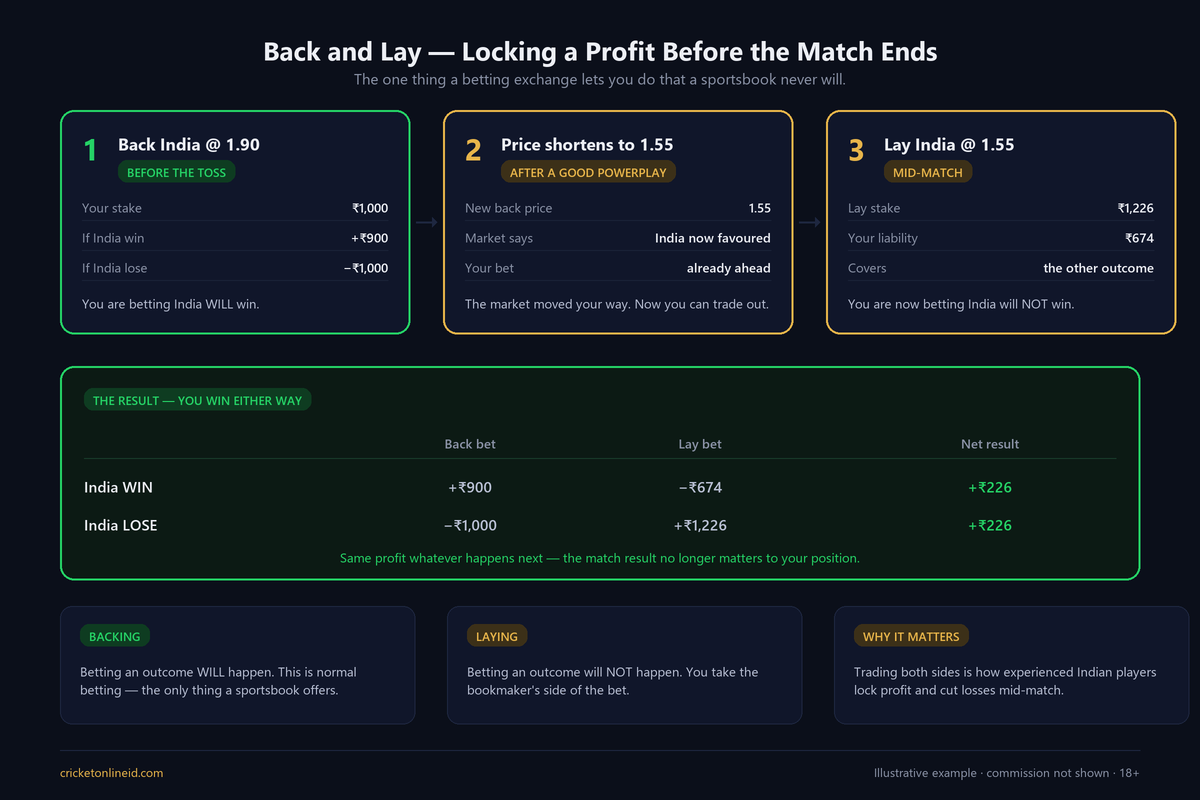
The honest trade-off: an exchange needs other players on the other side of your bet. During an IPL match, there’s more than enough. During an obscure domestic fixture, you may find nobody wants your bet at the price you want. That’s called liquidity, and it’s the one thing sportsbooks do better.
What a Cricket Betting ID Actually Costs
Nobody publishes this. Here it is.
The ID itself: free. You should never pay a “creation fee,” “activation charge,” or “processing cost” to get a cricket betting ID. A provider earns from the platform relationship, not from selling you a login. If someone quotes you a price for the ID, you’ve found a scammer — that’s the single cleanest scam test in this market.
Your deposit: whatever you choose. Minimums vary by exchange and are usually modest. We confirm the exact figure in writing before you pay.
Exchange commission: 2–5% of net winnings. This is the real cost of exchange betting, and it’s charged only on markets where you come out ahead. Lose a market, pay nothing on it. This is why exchange odds can look better than sportsbook odds and still be sustainable for the platform.
Withdrawal: free, in normal circumstances. Money returns to the same UPI account it came from. If a provider starts inventing withdrawal fees that weren’t disclosed upfront, that’s the beginning of a bad story — get your balance out.
Tax: 30% on winnings. See below. Almost nobody in this industry mentions it, which tells you something about the industry.
Tax on Cricket Betting Winnings in India
Here’s the section our competitors don’t write, presumably because it isn’t a good sales pitch.
Betting and gambling winnings in India are taxable. Under the Income Tax Act they’re taxed at a flat 30% (plus applicable cess), and unlike normal income there are no deductions, no exemptions, and no slab benefit — the 30% applies from the first rupee of winnings regardless of your total income. You also cannot set off your betting losses against your winnings, or against any other income. A year where you won ₹80,000 and lost ₹70,000 is not a ₹10,000 profit in tax terms.
Online gaming platforms operating within India are required to deduct tax at source on net winnings. (The Income Tax Department is the authority here, and the rules do change — check the current year rather than trusting any provider page, this one included.) Offshore exchange platforms — which is what most cricket betting IDs connect to — generally do not, which means the obligation to declare sits with you. Our guide to tax on betting winnings in India works through the arithmetic.
We’re an ID provider, not your accountant, and this is general information rather than tax advice. But you should know it exists before you start, and if your play is anything more than casual you should speak to a tax professional. Any provider implying your winnings are invisible or tax-free is either uninformed or lying to you, and neither is a good sign.
How to Get a Cricket Betting ID in India
Three steps, all inside one WhatsApp conversation.
1. Message us. Tell us which exchange you want — Lotus, Sky, Diamond, Cricbet99, 11xplay, Laser247 — or describe how you play and we’ll recommend one. If you’re new, ask for a demo ID first; it costs nothing.
2. Verify, then deposit. A quick KYC check, then payment by UPI, PhonePe or Google Pay. Before you send anything, we confirm the platform, the amount and any bonus conditions in writing in the chat. That message is your receipt — keep it.
3. Get your credentials and log in. ID and password arrive in the same chat, usually within five minutes. Change the password on first login.
Note the order: verification before payment. A provider who takes your money before establishing who you are has no reason to still be reachable next week. This is not a courtesy step, it’s the whole safety mechanism.
Your First Bet, Step by Step
New ID holders freeze at this screen, so here’s the walkthrough.
Open the exchange and find the match. You’ll see the two teams with numbers beside them — usually a blue box and a pink box for each. Blue is back (betting it happens). Pink is lay (betting it doesn’t). The number is the decimal odds: 1.90 means a winning ₹100 bet returns ₹190 total, so ₹90 profit before commission.
Click the blue box next to your team. A slip opens asking for your stake. Enter a small number — genuinely small, this is your first bet — and confirm. Your potential profit is displayed before you commit; read it, then place.
Now watch. Your bet sits as an open position and settles when that market resolves. If you backed the match winner, that’s at the end of the match. If you backed a session, it’s in a few overs. When it settles, your balance moves.
That’s it. The only thing that separates this from a ₹50,000 bet is the number you typed in the stake box — which is exactly why the first few weeks should have small numbers in it.
The Markets You’ll Actually Use
Match odds. Who wins. The simplest market, the deepest liquidity, and the right place to start.
Session and fancy markets. The classic Indian markets: runs in the first six overs, runs at the ten-over mark, a batter’s total, next-over runs. Sessions settle fast, don’t require you to predict the winner, and reward genuine cricket knowledge — knowing a pitch, knowing which bowler leaks at the death. Most experienced Indian players on a cricket betting ID spend most of their time here.
Toss and player props. Top batter, top bowler, method of dismissal. Small markets, quick answers, useful for staying engaged in a one-sided match without session-sized stakes.
In-play. Everything above, live, with odds moving ball by ball. In-play is the most exciting way to use a live cricket betting ID and by far the easiest way to overspend, because a new market opens every six balls and each one feels urgent. Watch one full match on a demo ID before you bet in-play with real money. The markets will still be there.
Bonuses, Decoded
Every platform offers a welcome bonus. Here’s how to read one.
A “100% welcome bonus” means your deposit is matched with bonus credit. What matters is the wagering requirement attached — the amount you must stake before that credit (or winnings from it) can be withdrawn. A 10x requirement on a ₹5,000 bonus means ₹50,000 of turnover before you see it.
That isn’t automatically bad; it’s just a condition, and a heavy player might clear it without noticing. What’s bad is not knowing about it. The scam pattern in this market isn’t fake bonuses — it’s real bonuses with conditions nobody mentions until you try to withdraw, at which point the goalposts have apparently always been there.
So: we put the wagering terms in writing before you deposit, and we’d rather quote you a smaller bonus you understand than a huge one you don’t. A bonus you can’t explain to a friend is not a bonus, it’s a lock on your own money — the bonus terms guide shows the wagering arithmetic. Anyone advertising 200–300% instant bonuses is not being generous.
Five Mistakes New Players Make
- Starting in-play. The fastest, loudest markets are the worst place to learn. Start with pre-match match odds.
- Betting the maximum the platform allows. Limits are not recommendations.
- Chasing. Doubling your stake after a loss is the single most reliable way to turn a bad evening into a bad month.
- Trading twelve markets at once. Learn one properly. Players who last know session betting cold; they don’t have positions open on everything.
- Never withdrawing. A balance that never leaves the platform isn’t a profit, it’s a float. Take money out regularly — it also proves your pipeline works.
When Something Goes Wrong
Also missing from every competitor page, so let’s be specific.
A market settles wrong. Screenshot the market and your bet slip, then message your provider. Exchange settlement can be corrected, but not without evidence — which is why screenshots matter more than arguments.
A match is abandoned or rained off. The exchange settles by its published rules: completed session markets generally stand, undecided markets are voided and stakes returned. Rules vary slightly by platform. Ask before a rain-threatened match, not after.
A withdrawal is slow. Ask for a timeline. A real provider gives you one — even an inconvenient one. Going quiet is the signal, not the delay itself.
Your provider stops responding. This is the failure that costs people real money, and the only reliable defence is the one you build early: verify before you pay, keep everything in writing, withdraw regularly, and never hold a large balance with anyone you haven’t tested. If you did those things, a bad provider costs you an evening. If you didn’t, it costs you your balance.
Why Get Your Cricket Betting ID From Us
We’re not going to claim we’re India’s number one anything — every page in this market says that, which is precisely why it means nothing. Here’s what we actually do differently:
- KYC before money. Every ID issued after verification. It’s the step scammers skip.
- Terms in writing. Platform, deposit, bonus conditions, withdrawal rules — in the chat, before you pay.
- Same-UPI withdrawals. Winnings return to the account the deposit came from. Traceable both ways.
- Real humans, 24/7. Under two minutes, average, including during matches.
- We tell you the boring parts. Commission. Tax. Wagering requirements. The stuff a sales page omits.
Not sure which exchange suits how you bet? Our honest cricket exchange comparison walks through it by player type.
Test us with a small deposit and an early withdrawal before you trust us with anything meaningful. We recommend that with every provider, ourselves included.
Commission and settlement speed depend on the platform rather than the provider: a Sky Exchange cricket ID and a Lotus Exchange cricket ID price liquidity differently, and a Diamond Exchange cricket ID is generally built for higher limits.
Frequently Asked Questions
What is a cricket betting ID?
A login — username and password — for a cricket betting exchange, used to see live odds, place bets, and manage deposits and withdrawals. Providers create it on the exchange for you and deliver the credentials on WhatsApp.
How much does a cricket betting ID cost?
The ID is free. You fund your own betting balance and the exchange takes a commission of roughly 2–5% on net winnings. Anyone charging a fee to create the ID itself is a scammer.
What is the difference between a cricket ID and an exchange betting ID?
Nothing in everyday use — the same login under different names. The distinction worth knowing is exchange versus sportsbook: on an exchange you bet against other players at market odds and can lay as well as back.
How long does it take to get a betting ID in India?
Around five minutes on WhatsApp once KYC is done. Verification itself is a one-time step, usually under ten minutes.
Can I get a cricket betting ID without KYC?
You can somewhere, and you shouldn’t. A provider who doesn’t want to know who you are has no accountability when your withdrawal is refused. We don’t issue IDs without verification.
Do I pay tax on cricket betting winnings in India?
Winnings are taxable at a flat 30% plus cess, with no deductions and no set-off of losses. Offshore platforms generally don’t deduct it at source, so declaring it is your responsibility. Speak to a tax professional if you play seriously.
What is the minimum deposit for a cricket betting ID?
It depends on the exchange. We confirm the exact minimum in writing before you pay anything.
Is a live cricket betting ID different from a normal one?
No — it’s the same ID. “Live” or “in-play” describes betting during the match, which every exchange ID we issue supports.
Can I use one betting ID on multiple exchanges?
No. Each exchange needs its own ID, but your KYC carries over with us, so a second one takes minutes. Many players hold two and compare odds before big matches.
Ready? Message us on WhatsApp and your cricket betting ID will be live in about five minutes. 18+ only. Bet responsibly, and only what you can afford to lose.