KYC is the step most people want to skip, and the one that matters most if anything ever goes wrong.
The instinct is understandable. You’re being asked for identity documents by someone you met through a WhatsApp message, in a market with a real fraud problem. Caution is the correct reflex.
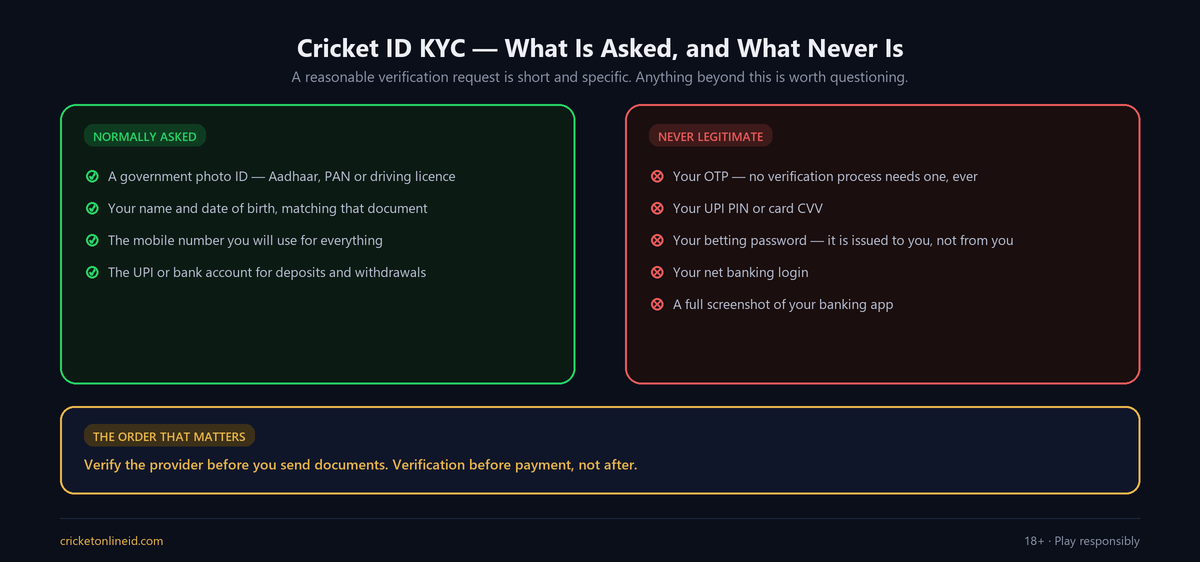
A trusted online cricket ID provider asks for documents in a predictable order, and never for the things listed further down this page.
But the conclusion people draw from that caution is usually backwards. A provider who doesn’t want to know who you are hasn’t done you a favour — they’ve removed the only mechanism that makes them accountable to you.
This page explains what KYC actually involves, what a reasonable request looks like, what should never be asked, and what verification does for you when a dispute happens.
What KYC Means Here
KYC stands for “Know Your Customer” — the general practice of verifying who someone is before providing a service. Banks do it, telecoms do it, and providers in this market do it.
Practically, for a cricket ID it means: you confirm your identity once, before an account is issued in your name.
It is a one-time step. It does not repeat every time you deposit, and with the same provider it should carry over if you later add a second exchange ID.
What Is Normally Requested
A reasonable verification request is short and specific:
A government photo ID. Aadhaar, PAN or driving licence are the common ones. This establishes that you are who you say you are.
Your name and date of birth, matching that document — including confirming you’re 18 or over.
The mobile number you’ll use. This becomes your permanent contact for everything: deposits, withdrawals, password resets.
The UPI or bank account you’ll use. Because withdrawals go back to the same account the deposit came from, this needs establishing at the start.
That’s the shape of it. If a request is much larger than this, it’s worth asking why each item is needed.
What Should Never Be Asked
This list is absolute. There is no legitimate version of any of these requests, from anyone, including us.
Your OTP. No verification process requires an OTP from you. A request for one is an attempt to access an account in your name — a bank account, a wallet, or the betting account itself. Every time, without exception.
Your UPI PIN or card CVV. These authorise payments. Nothing about verifying identity requires the ability to move money.
Your betting password. A provider issues it to you. They never need it back, and you should change it on first login anyway.
Your net banking login. Not needed, not appropriate.
A full screenshot of your banking app. For a payment, a transaction reference number is sufficient. A full screenshot exposes your balance and unrelated transactions to no purpose.
If any of these are asked for during “verification,” the process has stopped being verification.
The Order Matters More Than the Documents
Here is the single most useful thing on this page.
Verification should come before payment. Not after.
That sequence is what makes the whole thing work. When a provider verifies you first, they’ve established a record and taken on an obligation before receiving anything. When money moves first and questions come later — or never — there’s no record and no obligation.
There’s a corollary that’s just as important: verify the provider before you send them your documents.
Identity documents are valuable. Before sending them anywhere:
- Take the contact number from the provider’s own website, not from a search result, group, video description or social post
- Check a real site sits behind it — terms, privacy policy, contact, actual content
- Ask a specific operational question and see whether you get a specific answer
The full method is in the WhatsApp verification guide. Do those checks first, then send documents. Not the other way round.
What Verification Actually Does For You
Four concrete things, and they only become visible when something goes wrong:
It proves the account is yours. If a withdrawal is questioned or delayed, you can establish ownership. Without verification, you’re asserting it.
It makes password recovery possible. Locked out of an unverified account, there is no way for anyone to confirm you’re the owner. That account is effectively gone, and no support process can fix it.
It gives a dispute two identified parties. Disputes get resolved when both sides are known. An anonymous relationship has nothing to resolve.
It creates a record with a timestamp. Combined with your written terms and chat history, that record is what answers questions later — whether the question comes from your provider, or from anyone else.
None of that matters on a normal day. All of it matters on a bad one.
Why “No KYC” Offers Exist
It’s worth being direct about the economics, because the offer sounds generous and isn’t.
An operator who never establishes who their customers are has: no record of who is owed what, no obligation attached to any particular person, and nothing tying them to a transaction if they stop responding.
That’s not an oversight. It’s an exit — built in advance, at the customer’s expense.
The convenience is real. It just isn’t yours. You save ten minutes at signup and give up the only thing that would help you if a withdrawal is refused three months later.
This is why “instant ID, no documents needed” reads as an advantage in an advert and as a warning sign to anyone who has watched this market for a while.
Handling Your Documents Sensibly
Some habits worth keeping regardless of who you’re dealing with:
Verify first, send second. Covered above, and it’s the main one.
Send to one thread only. Your established conversation, on the number you took from the website. Never to a new number that contacted you, however plausible.
Send what’s asked, not more. If a photo ID is requested, send that. There’s no reason to volunteer additional documents.
Keep your own copy of what you sent and when. Part of your record.
Be alert to re-requests. If someone asks you to “re-verify” out of the blue — especially with urgency, or from a different number — stop and confirm in your original thread. Re-verification requests are a known approach for extracting documents from people who have already been through the process once.
Common Questions About the Process
“How long does it take?” Usually under ten minutes if you have a document ready. It’s a one-time step.
“Do I have to do it again for a second exchange?” Not with the same provider. Verification carries over, which is why a second ID typically takes minutes rather than a fresh signup.
“Can someone else’s account be used for deposits?” No — and it’s worth understanding why beyond the rule itself. Withdrawals return to the depositing account, so using someone else’s means the money doesn’t come back to you. There are also wider reasons to keep transactions on your own account, covered in the withdrawal guide.
“What if I already have an unverified ID?” Ask your provider to complete verification now. If they can’t or won’t, that itself is information — and it’s worth reducing what you hold on that account.
Summary
- KYC is one-time, and should be short: a government photo ID, your details, your number, your payment account.
- OTP, UPI PIN, CVV, passwords and net banking logins are never part of it.
- Verification before payment is the sequence that matters.
- Verify the provider before sending documents — website number, real site, specific answers.
- Verification is what lets you prove ownership, recover access, and resolve a dispute.
- “No KYC” removes the provider’s accountability, not yours.
What gets asked also depends on the account itself, which is covered in our guide to cricket ID types.
Frequently Asked Questions
What documents are needed for cricket ID KYC?
Normally a government photo ID such as Aadhaar, PAN or a driving licence, along with your name, date of birth, the mobile number you’ll use, and the UPI or bank account for deposits and withdrawals.
How long does cricket ID KYC take?
Usually under ten minutes if you have a document ready. It is a one-time step and should carry over with the same provider if you add a second exchange ID later.
Can I get a cricket ID without KYC?
Some operators offer that. The trade-off is that verification is the mechanism that makes a provider accountable — without it, you cannot prove the account is yours if a withdrawal is disputed or you lose access.
Should I ever share an OTP during verification?
No. No verification process requires an OTP from you. A request for one is an attempt to access an account in your name.
Is it safe to send Aadhaar or PAN on WhatsApp?
Verify the provider first — take their number from their own website, confirm a real site sits behind it, and ask a specific operational question. Send documents only after those checks, to your established thread, and only what’s requested.
Does KYC need to be repeated for each exchange?
Not with the same provider. Verification carries over, which is why adding a second exchange ID is usually quick.
Someone is asking me to re-verify from a new number — is that normal?
Treat it with caution and confirm in your original thread first. Unexpected re-verification requests, particularly urgent ones from a new number, are a known method of extracting documents.
What happens if I lose access to an unverified account?
There is generally no way for anyone to confirm you are the owner, which means the account cannot be recovered. This is the most common practical consequence of skipping verification.
Questions about the verification process? Ask before you send anything — that’s the right order. 18+ only.
Ready for your online cricket ID? Verified IDs for every major exchange, delivered on WhatsApp in minutes.
Get ID on WhatsApp