Almost nobody in this industry writes about tax, and the reason is obvious: it isn’t a good sales pitch. But it’s a real part of what happens to your money, and not knowing about it doesn’t make it go away.
So here is a plain, neutral explanation of how winnings from betting and gaming are treated under Indian income tax rules — what the rate is, why it works differently from ordinary income, and what records are worth keeping.
Two things to be clear about before you read on.
First: this is general information, not tax advice. We are an ID provider, not accountants or lawyers. Tax rules change, they interact with your personal circumstances, and nothing here is a substitute for a qualified professional looking at your actual situation.
Second: India’s legal framework for online real-money gaming changed in 2025–26. The Promotion and Regulation of Online Gaming Act, 2025 received assent in August 2025 and came into force on 1 May 2026, and a constitutional challenge to it is pending before the Supreme Court. The position continues to develop. Anything you read about this subject — here or anywhere — should be checked against the current position with a professional.
The Headline: A Flat 30%
Under Indian income tax rules, winnings from betting, gambling, lotteries, card games and similar sources are taxed at a flat rate of 30%, plus applicable surcharge and cess.
This sits in a separate category from your salary or business income, and that separation is what produces the effects below.
What “flat” means in practice: the 30% applies from the first rupee of winnings. There is no threshold below which the rate is lower, and no slab system — a person with no other income and a person in the highest tax bracket face the same rate on this particular category.
Three Rules That Surprise People
These are the parts that differ most from ordinary income, and they’re where most misunderstandings live.
1. No deductions
With most income, you can deduct expenses incurred in earning it. In this category you generally cannot. There is no deduction for a subscription, a data plan, or anything else you spent while playing.
2. No basic exemption benefit
Ordinary income enjoys a basic exemption limit before tax applies. Winnings in this category are generally taxed at the flat rate regardless of whether your total income is below that limit.
3. Losses cannot be set off — this is the big one
You cannot offset losing bets against winning ones, and you cannot set these losses against any other income.
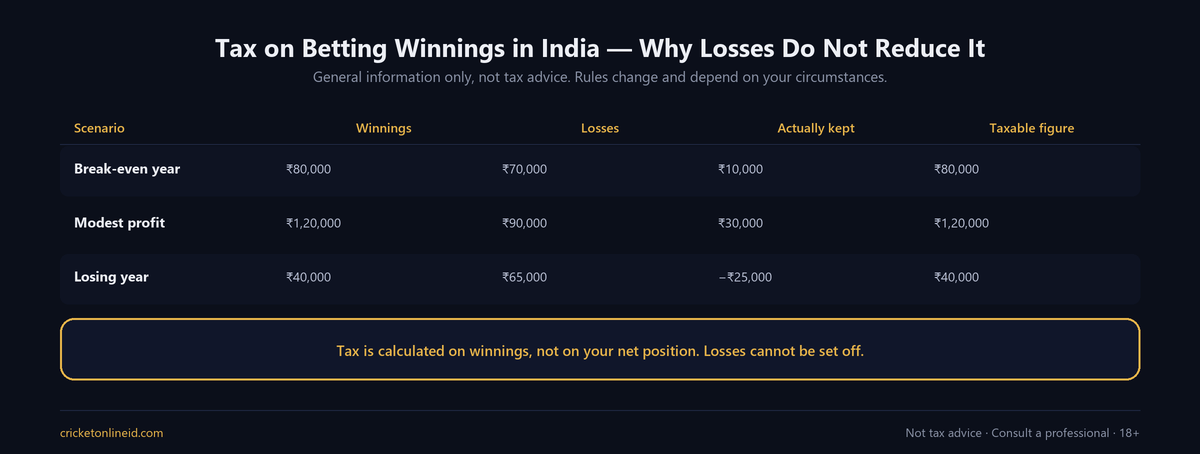
This is the rule that surprises people most, so here is the arithmetic:
| Amount | |
|---|---|
| Total winnings across the year | ₹80,000 |
| Total losses across the year | ₹70,000 |
| What you actually kept | ₹10,000 |
| What is taxable | ₹80,000 |
The tax is calculated on the winnings figure, not on your net position. Someone who finished the year roughly level can still have a tax liability.
Whether “winnings” means each individual win or a net figure per session or platform is exactly the kind of question that depends on facts and on current rules — and exactly the kind of question to put to a professional rather than to a betting website.
TDS — Tax Deducted at Source
Separately from what you owe, there are rules about tax being deducted before money reaches you.
Indian law provides for TDS on winnings, and specific provisions have been introduced covering winnings from online games. Where these apply, a platform or payer is required to deduct tax before paying out, and you would receive the net amount.
The practical point for most people reading this: platforms operating outside India generally do not deduct Indian TDS. There is no Indian payer in the chain to make the deduction.
That does not make the income untaxed. It means the obligation to declare it sits with you, rather than being handled automatically before the money arrives.
TDS is also not the end of the calculation — it is tax collected in advance, which is then reconciled against your actual liability when you file. Depending on circumstances you might owe more, or be due a refund.
Records Worth Keeping
Whatever your position turns out to be, records make it easier to establish. These are worth keeping as a matter of habit:
- Bank and UPI statements showing deposits and withdrawals
- Transaction references for each payment in and out
- Your provider chat history — timestamps, amounts and confirmations
- Platform statements where the platform provides them
- Any TDS certificates if tax was deducted
The reason is simple: if a question ever arises, the person with records can answer it and the person without records cannot. That holds true whether the question comes from a tax professional helping you file, or from anyone else.
Keeping deposits and withdrawals on one account — the same-account rule we describe in the withdrawal guide — also makes that record much easier to reconstruct.
GST Is a Separate Thing
You may see GST mentioned alongside this subject. It is a different tax on a different party.
GST applies to the supply of services and is a matter between the tax authorities and the operator. Income tax on winnings is a matter between the tax authorities and you. They are separate obligations with separate rules.
The relevance to a player is mostly this: if anyone contacts you asking for a “GST payment” or “tax payment” to release your winnings, that is not how tax works. Tax is not collected by a provider over WhatsApp in exchange for a withdrawal. That specific request is a known fraud pattern, covered in the scam guide.
What This Means Practically
Neutral summary, no recommendations:
- Winnings in this category are taxable at a flat 30% plus applicable surcharge and cess.
- Losses do not reduce that figure.
- Offshore platforms generally do not deduct Indian TDS, so declaration falls to the individual.
- Records make any of this easier to handle.
- Rules in this area have changed recently and continue to develop.
- A qualified tax professional is the right person to apply any of it to your actual circumstances.
And one observation that follows from the arithmetic rather than from any opinion: because losses cannot be offset, the tax treatment is least favourable for high-turnover, roughly-break-even activity — a lot of winning bets and a lot of losing bets producing a small net result. That is simply what the rules produce; whether it matters to you depends entirely on how you play.
Frequently Asked Questions
What is the tax rate on betting winnings in India?
Winnings from betting, gambling, lotteries and similar sources are taxed at a flat 30%, plus applicable surcharge and cess. This is general information and not tax advice.
Can I set off my betting losses against my winnings?
Under the rules governing this category, losses generally cannot be set off against winnings, or against any other income. Tax is calculated on winnings rather than on your net position.
Does the basic exemption limit apply to winnings?
Winnings in this category are generally taxed at the flat rate regardless of whether total income falls below the basic exemption limit. A professional can confirm how this applies to your circumstances.
Do offshore platforms deduct TDS?
Platforms operating outside India generally do not deduct Indian TDS, as there is no Indian payer in the chain. That does not change whether the income is taxable — it changes who is responsible for declaring it.
What records should I keep?
Bank and UPI statements, transaction references, provider chat history, platform statements where available, and any TDS certificates. Records are what allow a question to be answered later.
Someone is asking me to pay tax to release my winnings — is that normal?
No. Tax is not collected by a provider in exchange for processing a withdrawal. That request is a recognised fraud pattern and no legitimate version of it exists.
Is GST the same as tax on my winnings?
No. GST applies to the supply of services and is an operator-side matter. Income tax on winnings is a separate obligation with separate rules.
Has the law in this area changed recently?
Yes. India’s framework for online real-money gaming changed in 2025–26, with the Promotion and Regulation of Online Gaming Act, 2025 coming into force on 1 May 2026 and a constitutional challenge pending before the Supreme Court. The position continues to develop.
Is this page legal or tax advice?
No. It is general information published by an ID provider, not by lawyers or accountants. Please check your own position with a qualified professional.
General information only — not tax or legal advice. For your own circumstances, speak to a qualified professional. 18+ only.
Ready for your online cricket ID? Verified IDs for every major exchange, delivered on WhatsApp in minutes.
Get ID on WhatsApp